Friday, 16 January 2009

Window shopping


Hull City have been in obvious need of strengthening lately, and the arrivals of both Kevin Kilbane and Manucho represent some astute business by Phil Brown.

Kilbane is a fine footballer, if not necessarily highly gifted, and his level-headed approach down our left flank will be a sharp contrast to the slightly tunnel-visioned style of Peter Halmosi, who is not taking the chances he has recently been offered.

Manucho, meanwhile, is an Angolan centre forward who hasn't been able to earn enough faith from Sir Alex Ferguson to pull on a Manchester United strip with anything resembling regularity. At 25, he needs to playing more often, and given our excellent recent record for taking fringe Manchester United strikers and developing their talents, one hopes the benefit felt by Manucho's arrival will be three-fold, just as it was when Fraizer Campbell did the business for the Tigers last season.

Manucho's arrival does rule out a return to the KC Stadium for Paul McShane, unless Brown feels the ginger-haired defender is worth a punt as a permanent acquisition. Manucho has taken McShane's place on the loan list, and the presence of Kamil Zayatte and Marlon King means the quota is again complete. The pursual of Steve Finnan, which the manager says is still alive despite worries regarding his medical, could put paid to any lingering interest in McShane, temporary or otherwise.

We still need a central defender and one hopes we get one quickly, as McShane has gone, Zayatte is suspended and Anthony Gardner remains forever crocked. This is unless Wayne Brown is our secret weapon for the visit of Arsenal...

Thursday, 15 January 2009

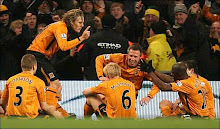
FA Cup third round replay: Newcastle United 0 - 1 Hull City - 14/01/2009


It's a genuine joy to see Hull City take a place in the fourth round of the FA Cup for the first time in two decades. The last time we won a third round tie was in 1989, when goals from oft-forgotten full back Nicky Brown and the unforgettable Keith Edwards earned a 2-1 win at Cardiff City.

There was much to cheer from this performance at a muted St James' Park - the resplendent white kit commissioned especially for the occasion, the strong side Phil Brown selected (despite making eight changes from the defeat at Everton) and the way the players responded to the occasion. Backed by a 1,000-strong support of loudness, the better side won.

For all the changes, most of the team had tasted Premier League semi-regularity at the very least this season - only keeper Matt Duke, full back Nathan Doyle and midfielder Ryan France were genuinely clipped from the fringes of the squad to play - and it was a strong 4-5-1 with ample width and plenty of industry which dug out the passageway to the next round, having drawn 0-0 at the KC eleven days earlier.

Newcastle picked a strong-looking side too, despite Joe Kinnear getting his excuse in first by moaning about having 11 first-teamers absent, and a spine of Shay Given, Fabricio Coloccini, Nicky Butt and Michael Owen should be capable of winning most Cup ties. But they didn't, with Coloccini given a hard time by Daniel Cousin and Owen being unusually profligate with the chances which did fly his way.

City began strongly, with Richard Garcia doing well to reach a searching slide-rule ball from George Boateng, but Peter Halmosi was double-whammied as he made for the Aussie's cross - he was tackled well by David Edgar and flagged for offside.

The linesman's flag was a common motif for City in the first half, showing as it did plentifully as Cousin, in particular, failed incessantly to time his runs as the likes of Garcia, France and Craig Fagan all tired to set the Gabonese marksman clear. Frustrating as it was, it also meant that City were on top.

Newcastle's first proper go came when Jonas Gutierrez escaped down the right with lots of room, delivering a low ball towards Xisco - scorer of Newcastle's goal when we won there in the Premier League - but the daft striker spooned a gilt-edged chance both high and wide and took a good deal of bad-natured Geordie stick for it.

Doyle fouled Damien Duff on the edge of the area and Butt struck the crossbar with a firm header from Danny Guthrie's whipped free kick as the home side began to exert some real pressure, yet Duke was being left with little more to do than catch wayward crosses as Newcastle's finishing was beyond lacklustre.

On 25 minutes, Coloccini went in very late on Cousin, right in front of the technical areas, and as City's centre forward lay in pain, the two managers squared up over the illegality of the tackle. The referee, Phil Dowd, decided to take no nonsense from two of the more volatile dugout figures and sent them both to the stands, though only Brown went on instruction. Kinnear chose to shout his mouth off a little more first.


Newcastle carved out their best chance when Paul McShane and Kamil Zayatte - central defensive partners for the evening - ran into each other as the homed in on the same ball, and Owen was set free. His hasty shot was quite appalling.

City then got the ball in the net through Garcia's low drive from a half-cleared set-piece, but the whistle had gone for a shove by person unknown on further person unknown seen by spectators unknown.

Doyle struck an injury time volley wide as the first half withered and died, but there was real promise in City's play. Fagan and Halmosi, the wide men, were making plenty of breaks, Cousin was strong and resourceful down the middle and Garcia and France were making headway and covering the necessary yardage in support. There was a Cup tie to be won if Brown fancied it.

The second half, and immediately City are let off as Owen chases a long ball, looking suspiciously offside, but his stabbed effort pretty much hits Duke and trundles wide. Duke did all he could and got lucky while his team-mates surrounded the referee about the lack of flag. As if galvanised by this bit of near-injustice, City began to dominate. Zayatte went on one of those madcap runs of his, jumping over tackles without any real clue as to where he would end up, but as he finally shaped to shoot, Edgar got in a smart block.

Fagan, quiet and unwittily booed by the home side (as if he broke his leg deliberately), hit a left-foot volley of too much ambition which Given caught easily, then began a sterling counter attack down his flank, releasing Cousin through the channel, whose centre was played back by Halmosi for Boateng to hit, but another hefty block came in which deflected the shot away and rendered the City midfielder unable to continue. As he was stretchered away, Ian Ashbee joined in the fun.

Wantaway, self-praising Newcastle flanker Charles N'Zogbia then nipped through three powderpuff City challenges before Zayatte made up for the ineptitude by strongly snuffing out the full back's shot.

With about 15 minutes to go, Brown withdrew Fagan and slung on Bernard Mendy, knowing that any sort of headstrong cameo from the demented Frenchman could be the difference between a victory and an extra 30 minutes. And so it proved - within five minutes of his introduction, Mendy had swerved in and out of Duff and N'Zogbia and tried a left-foot shot which deflected perfectly for the onrushing Garcia, who coolly put a low ball into the six yard box for Cousin to stroke home.

A breakthrough in this long old Cup tie at last, and it had gone to the correct team at the correct time.

Newcastle didn't have much in response - Owen headed one chance high over the bar and Given, as if to prove Newcastle cared about the FA Cup, came up for two injury time set-pieces, both of which Duke dealt with comfortably.

The final whistle was greeted with glee and relief, not just because we'd won a game about which the club had uttered less than enthusiastic platitudes about winning, and not just because, finally, we'd progress from the third round of the FA Cup. A primary emotion from this game is the knock-on effect it could have on our Premier League form, and even though the alleged write-off match that is Arsenal's visit to the KC is this weekend, we know what City are capable of when the spirit and togetherness of the squad is reaching a nice peak.

Add to all that the less than frightening prospect of a League One club coming to ours for the fourth round and the performance of numerous fringe players which gives Brown a selection headache for the weekend, and maybe the future is looking just a little rosier. A Cup run could do us all the world of good.

Newcastle United: Given, Edgar, Bassong, Coloccini, N'Zogbia, Gutierrez (LuaLua 82), Butt, Guthrie, Duff, Owen, Xisco (Carroll 76). Subs not used: Harper, Taylor, Kadar, Donaldson, Ranger.

Hull City
: Duke, Doyle, McShane, Zayatte, Ricketts, Fagan (Mendy 74), Halmosi, Boateng (Ashbee 67), France, Garcia, Cousin (Folan 86). Subs not used: Warner, Featherstone, Giannakopoulos, Atkinson.

Wednesday, 14 January 2009

Tigers and Lions


It's Millwall who await tonight's winners of the FA Cup replay. Now, we knew anyway that we'd have a home tie against a League One side if we won at Newcastle United, but somehow the actual identity of that team surely offers Phil Brown enough incentive to pick a strong side at St James Park.

Mind you, even if we do win tonight, I don't fancy a midweek replay down at the New Den if we take the fourth round tie too lightly. That tunnel walk from Bermondsey station to the ground is petrifying. The simple way to avoid all this debate is win tonight, win the fourth round tie at the KC and win the Cup itself.

Tuesday, 13 January 2009

Burned Bridges


Michael Bridges did at the weekend what all Hull City players should do in such a situation - scored a goal which condemned Leeds United to an annoying defeat. As an ex-Leeds player (who was actually fantastic when he played for them), he chose not to celebrate the goal. One can't help but feel he wouldn't offer the same courtesy to the Tigers were he ever to notch one against us.

It's quite hard to believe that Bridges is still a City player, and the fact that he isn't leading a Premier League front line but is instead back in Cumbria, on loan and playing League One football, is a naked indication of what a wasted career he has had. He was very unfortunate with injuries in his earlier days - three years of his five at Leeds, during their overblown Champions League era too, were spent in rehab - but the latter act of wastefulness has been down to the player's own poor attitude.

Bridges was raised at Sunderland before Leeds spent a fortune on a lad who was clearly very exciting. Injury ruined his chances of helping Leeds reach their financially suicidal targets, but he rebuilt his body and his career with short spells, either through loans or quick deals, with Newcastle United, Bolton Wanderers and Sunderland again. Ultimately he dropped down the divisions to be properly noticed, with a fine promotion season at Carlisle United prompting Phil Parkinson, new to City and with a sterile, unimaginative side already threatening his job, to pay £350,000 for him in August 2006.

The tall, skilful centre forward made an instant impact, playing a blinder on his debut at Birmingham City despite a 2-1 defeat, then scoring what is still one of the best Hull City strikes I've ever seen. Still searching for the first win as we went to Leicester City on a windy September night, Bridges collected a ball at 30 yards' distance and after two seconds of preparation, curled a phenomenal left-footer into the top corner of the net, earning that long-awaited opening victory for the season and for Parkinson.

That was it. He'd peaked already, even though all the Tiger Nation could believe as we exited the Walkers Stadium with wide grins was that we had a new talisman, a saviour, a chap with the required quality and optimism to create and execute enough goals and moments of magic to pull us from the mire.

Not so. Bridges struggled again with injury, and then as the team's fortunes failed to improve, struggled with Phil Brown as manager once Parkinson had exited stage left. Brown adopted a 4-3-3 formation, a tactic which would work just as well when trying to avoid relegation from the Championship as it would later when trying to surprise illustrious Premier League opponents on their own turf.

Bridges didn't even slightly suit a lone striker's role with two wide attackers providing only occasional support, but it proved a turn in fortune for Nicky Forster, the ageing, experienced striker who was purchased on the same day as Bridges and whose impact thus far had been barely measurable. Forster's attitude pleased Brown, and his pace and willingness to run like billyo all day and night made him ideal for this new system. He scored a few goals but made such a sterling effort beyond his strike rate that the 4-3-3 was soon being re-adapted to suit his needs as a man capable of playing the flanks and channels.

Bridges came on as a substitute against Cardiff and scored the fourth goal of a 4-1 win, but that was the summary of his season's contribution. His head dropped and Brown, already needing to remove Jon Parkin and his stinking attitude from the picture, began to phase Bridges out of the equation too. He still featured through the season but by January, Dean Windass had returned on loan and in all his glory, and Brown was still showing faith in the strike-free but effort-blessed Stephen McPhee. Bridges featured in one game in the January, one in the February and one in the April, all of which ended in defeat. City stayed up with a match to spare in the end, but it was Windass and McPhee who completed the trio up front with Forster. Bridges was nowhere to be seen.

With safety assured and a new regime in place upstairs, Brown now had his mandate pinned to his office wall and began to exercise a proper clean-up operation on his squad, and the forward line was given a severe vacuuming. Forster wanted to return south as his family were still there and so he left with everyone's thanks. Windass signed up permanently and Parkin, along with the nippy but confidence-shorn Darryl Duffy, left after loan spells elsewhere had made them saleable assets. McPhee hung around, despite still not scoring a single goal since Taylor had signed him in 2005 (he did have a back injury which took almost a year to heal) and so did Bridges. Both scored in a League Cup tie at Crewe and Bridges, peripherally involved in the Championship so far, earned himself a start at Sheffield Wednesday. Although a striking crisis had forced Brown's hand - new £1m signing Caleb Folan had suffered a fractured skull on his debut a couple of weeks earlier - this still represented a big chance for Bridges, a big test of his mettle and the manager's faith, and against a club from whom we regularly took points at Hillsborough and who it was always a big thrill to outplay.

The team played poorly, despite the home side's only goal coming via a freak Francis Jeffers shot, but Bridges was as uninterested and uninspiring as he could have ever been. The fans were livid with his lack of application and certainly Brown made his feelings plain thereafter. Wanting him as far from his sight as possible, Brown packed Bridges off on loan to Sydney FC in Australia - not that such a move disappointed Bridges, given that he was going to a warm climate while still earning high Championship wages - and we all proceeded to forget about him, especially when a young striker called Fraizer Campbell was signing on loan from Manchester United just as Bridges was having his passport stamped.

While in Australia, Bridges said some unflattering things to the media there about Brown and Hull City and came across as a sourpuss and a real grump, unable to shoulder any of the blame for where it had all gone wrong for him at City. Given how close he had been as a younger player to losing his career through injury, and considering that City represented his first move back up the footballing ladder since the day he joined Leeds, it beggared belief that he was being so self-pitying and ungrateful. He wasn't in form - most players have that - but he was matching his lack of form with a lack of class, and it seemed that even though eventually he would have to return to Hull, there would be no discernible future for him at the KC.

In Australia, Bridges also struggled. He scored just twice in nine games, despite the supposed downturn in standards he was facing, and also had a public run-in with his coach. He returned to City forlorn, with little hope of being welcomed back with open arms, especially as the surge in form had activated real hopes of promotion to the Premier League. He came on as a sub in the 5-0 demolition of Southampton, having been picked because again there was an injury list to contend with, and just briefly during this sub appearance (albeit against a Southampton side who were utter rubbish) he showed flicks and touches which reminded us why he was once such a highly-regarded football player. He hit the post, prior to contributing to the fifth and final goal which was scored by Bryan Hughes. Yet it was a token appearance, one borne of necessity as opposed to any benevolence on the manager's part. Bridges has not played for Hull City since.

As the team maintained its rise towards glory, Bridges was nowhere to be seen, except the training ground and the odd reserve outing. I've no idea whether he went to Wembley as a member of staff (he certainly wasn't part of the squad) but the biggest stage in football was made for talents like his, providing those talents have the mental strength to use them in the correct manner. Though it would have crossed nobody's mind at the time, it did seem a shame that City were at Wembley and one of the club's most cultured players wasn't part of the experience. Bridges was escorted back to Carlisle in the summer for a year-long loan to keep him out of harm's way while City plough through the Premier League and his own contract runs down. Carlisle have first option on him in the summer.

This would be a sadder tale if it had happened during a struggle for City's very life, a scenario we remain far more used to than the current wave of high emotion, public congratulation and footballing achievement we are currently surfing. It still, nonetheless, maintains some sadness because of the way Bridges fought so hard to rescue his career from those terrible injuries when he was still in flushes of youth. Hull City represented a chance for Bridges to show again what he had prior to those darker days of rehab and surgery, and he blew it.

Sure, there will be his side to the tale, but we saw early evidence with those opening displays for the Tigers that the ability never left him, so how else could it have all gone wrong?

Monday, 12 January 2009

France of a lifetime


Ryan France was on the bench at Everton, his first ever time on a Premier League teamsheet. Now, with rumours aplenty that Blackpool want him, and Hull City doubtlessly happy to sell, could this possibly be Phil Brown succumbing to a spot of sentimentality?

France, as we know, has featured in the other three divisions for the Tigers, alongside Ian Ashbee, Boaz Myhill and Andy Dawson. But, unlike the others, he hasn't been a first-team regular since Peter Taylor left the club in 2006, and even under Taylor his security in the team varied according to whether we had any fit right backs or not.

One solitary appearance, even as a sub, in the Premier League for France will put him in Hull City's history annals forever. And with the transfer window open and rumours of Blackpool's interest heightening, he found himself on the bench at Goodison Park whereas previously his only first team action had been in the dismal Carling Cup defeat at Swansea City, where he played well but ultimately didn't do enough to secure any form of elevation to the main squad.

Has France, who was on the bench for the FA Cup tie last week without emerging on to the pitch, suddenly changed Brown's mind? His attitude has been that of an uncomplaining individual who appreciates his limitations and continues to do his work as best he can. Brown has never expressed a problem with him. Maybe, just maybe, France's way of coping with life as a fringe player with six months left of his Hull City career has, perversely, altered his manager's view of him.

Or maybe the demeanour of people like Richard Garcia, Bryan Hughes and Stelios Giannakopoulos has stunk so much that Brown decided a focussed France was a better option from the bench than these more gifted but more high-maintenance players.

Either way, it's largely irrelevant as France wasn't used, even though at 2-0 down with ten minutes left Brown could have slung him on instead of Peter Halmosi and given him his day in the (metaphorical) sun. Unused subs may get medals when they stay benched at major finals, but they don't get their appearance stats updated. France needs to run on to a Premier League pitch to contribute his tiny bit of Hull City history and at Everton, he came so close to a moment that may not come round again. That said, maybe the Blackpool rumours are just that, France is going to be here until the summer - and Brown has plans for him when Arsenal come to the KC this weekend...

Sunday, 11 January 2009

21: Everton 2 - 0 Hull City - 10/01/2009


If Hull City do get sucked down into the regions of the Premier League where the game's professors and eminent observers feel they belong, then days like this will be the reason for it.

You'd never believe the side which turned out at Goodison Park was one which had only lost two away games thus far in their maiden Premier League campaign, because it didn't look capable of kicking a ball in the right direction, never mind maintaining a form of travelling superiority.

Everton rarely needed to scrap - though they chose to anyway thanks to a couple of players whose vileness was beyond both reproach and, seemingly, the wrath of a weak referee - and ultimately they were worthy winners, barely cantering to the three points and making it four defeats in succession for the Tigers.

Phil Brown went for a 4-5-1, though the inclusion within the midfield quintet of both Nick Barmby and Geovanni suggested he was hoping there would be some fluidity within the structure, and these two would be able to support Marlon King as and when pattern of play allowed. Sadly, Geovanni offered next to nothing and Barmby, not shirking as far as effort was concerned, had little more to bring along.

Barmby had the first chance, scuffing a bobbly shot well away from Tim Howard's goal after his own flick had been returned to him by King. A counter attack begun by the blameless (and, at times, genuinely creative) Ian Ashbee led to a corner which King then swung in and Michael Turner headed too high.

Neither incident was anything to get too churned up about, but it was a start. Sadly, little more progress was made as Everton's midfield, led by the industrious Leon Osman and the resourceful but filthy Marouane Fellaini, took total command. Fellaini's elbows caused all sorts of unlawful problems but referee Martin Atkinson, one of the officials namechecked by ranting Rafael Benitez 24 hours earlier, somehow concluded that the Belgian had not committed an offence, even one punishable by a yellow card. Then, as if the salt wasn't digging into the gaping wound enough, Fellaini rose highest to nod home Leighton Baines' cross despite very, very offside. Mr Atkinson gave the goal and Everton's noses had pushed themselves frontwards thanks to one player whose contribution had, in order, been to flail his elbows into his opponents' faces, complain bitterly about nothing and then score a goal which shouldn't have been allowed. A charmed existence he doth lead.

City were dumbfounded and never recovered, even slightly, from the lack of justice on offer. Osman weaved through three defenders from the byline as if they didn't exist before sending a low ball in which, mercifully, got no form of deflection whatsoever. A subsequent ball in was met by Fellaini's auto-permed nut again, but the ball this time trundled wide. City's possessional spells were short and guileless, with too many players - Geovanni, Dean Marney, Bernard Mendy - unwilling or unable to do anything even remotely constructive with the ball.

Half time approaches and it's fortunate that 1-0 is the scoreline, as there is a game plan to be cooked up for a right go in the second half. That is soon shredded and discarded as Turner fouls Tim Cahill and the free kick, extremely central, goes through City's butter-like wall from Mikel Arteta's boot and flies comprehensively into the back of Boaz Myhill's net. No goalkeeper in the world would have got near it, but a better defensive wall would have made sure it wasn't an issue. Bad show.


City therefore trail by two as the players trudge indoors for linament and argument, and upon recommencement it's clear that Everton feel their work is done, as they choose to maintain possession, stifle City's sluggish attempts to make inroads and sporadically commit bad fouls, such as the one Cahill, a disgusting individual on occasions, manages with his studs as Myhill slides down to take a low through ball. Fortunately, he manages to take evasive action as Cahill's hanging boot, with the player knowing perfectly well the ball is simply not in the equation, comes close to the City keeper's face. Just before this, Fellaini finally gets the booking he deserves - his tenth of the season - but he should have had it, and more, long ago and the stable door may as well be shut again.

Ashbee tackles Osman superbly as the midfielder breaks and manages to procrastinate a little too much as the City area approaches, then the same Evertonian shoots over the bar after Victor Anichebe's smart link-up play makes a mockery of City's defensive positioning, prior to his own appalling dive in the box which, as it went unpunished, makes a mockery of the clampdown on simulation.

Late flurries from City hide the true picture, but nonetheless Turner is unlucky to be pulled for a foul as he challenges strongly for King's deep cross; then Ashbee sends an injury time volley well over the bar.

The final whistle heralds a professional and cynical performance from the home side and a worryingly lower-league display from the Tigers. With just seven points separating City from the relegation zone (albeit the lofty eighth position intact thanks to the neutralised nature of the division this season), Brown and his players have to embark on a rethink. New blood is required and a new - or recycled - attitude too. This doesn't feel like the same squad which took Premier League points in September and October than nobody in their right mind would have predicted. And only the squad themselves can regain that feeling.

Everton: Howard, Hibbert, Jagielka, Lescott, Baines, Osman, Arteta (Rodwell 90), Neville, Pienaar, Fellaini, Cahill (Anichebe 73). Subs not used: Nash, Van der Meyde, Castillo, Jutkiewicz, Gosling.

Hull City: Myhill, McShane (Halmosi 79), Zayatte, Turner, Ricketts, Mendy, Ashbee, Marney (Fagan 54), Geovanni (Cousin 66), Barmby, King. Subs not used: Duke, Doyle, France, Boateng.

Saturday, 10 January 2009

In the shadow of Mike


This is Mike Edwards, back in his Hull City days. Almost a decade since this photograph was taken and here we are, devouring stories of international superstars supposedly joining Hull City in this transfer window.

It makes the shadow of Edwards loom ever larger over the KC Stadium.

Edwards is 29 this year and is now the captain of Notts County. However, he began his career with his local club, Hull City, and remains very much on the club's radar as the last homegrown player to emerge through the ranks to become a fully-fledged first-team regular.

Of course, the presence of Dean Windass and Nick Barmby in recent seasons has made sure a quota of local talent has been present in the club's rise under Peter Taylor (who signed Barmby, but rejected the chance to reclaim Windass) and Phil Brown (who did reclaim Windass and revived the input of Barmby). But now, with Windass gone almost certainly for good and Barmby trying to shrug off questions about the lack of a contract extension, the bit of Hull within Hull City's squad is starting to look sparse.

And, of course, neither of these players came through the ranks. Barmby was way too good as a kid to consider a second-tier Hull City for his apprenticeship in the late 1980s, especially once Lilleshall offered him a place to simultaneously complete his academic education and begin his footballing education. That didn't stop Brian Horton offering the world to our city's finest ever player to get him to Boothferry Park, but ultimately he was correct to let his head rule his heart and join Tottenham Hotspur. An excellent, if not world-beating, club and international career followed..

Windass was an apprentice with the Tigers but Horton decided he wasn't up to the job and, while the likes of Leigh Jenkinson and Neil Buckley signed pro forms, Windass became a labourer and signed for North Ferriby United, where four years later his game had developed enough for Terry Dolan, needing to recruit talent without spending money, to take a chance on him. He duly became the best footballer Hull City had in the 1990s.

Brown has always gushed about Barmby's professionalism and ability, though one can't say he has done likewise over Windass. The class act at lower levels Windass undoubtedly is has not crossed the Premier League threshold well at all. His age - he's 40 in April, remember - will be a crucial factor in his demise, but ultimately he has been with Hull City in this division what he was in his previous top flight spells with Bradford City and Middlesbrough - peripheral, ordinary and high-maintenance. Brown and Windass were bosom buddies prior to this season, with Windass owing Brown for offering him his dream moved home to Hull again (leaping a division in the process) and Brown owing him back for making a season-saving impact on the Tigers and then making a sterling contribution to a brilliant season for the whole team, with the Wembley winner adding the cherry to the cake.

It's been said time and again, but Windass has been hoisted by his own petard. His goal at Wembley, iconic and immortal a moment it may remain, ended his Hull City career. He was never going to be quick, fit or reliable enough (not to mention prolific) in the highest echelon of the game but his personality, intelligence quotient - and his media contracts with ITV and the Daily Mail - meant he was never going to be able to keep mum about it and get his head down. On just one too many occasions he has used his column inches to moan about his lack of involvement, something which the club could just put down to his natural character, but when he then claimed - daftly - that his manager hadn't spoken to him for three weeks, the camel's back gave way. Until this point, he did have a future as a reserve, a replacement, a cameo performer who could still do some form of job, although only an injury-crisis compared to the English Civil War would have seen him start another game after his embarrassing canter around on Boxing Day at Manchester City.

Windass, gratifyingly with a Premier League goal for Hull City to his name after that noser at Portsmouth was awarded officially to him, has now dropped back into League One, the division from whence he came, and Oldham Athletic are the club who will feel the considerable benefit of his experience, while at that level he will be able - like Barmby for City in his first season - to rule the whole division and play with his tuxedo on and cigar sparked up.

One assumes there is a recall clause in the deal, allowing the Tigers to send for Windass if the injuries stack up after January, but Brown will be loath to use it. He and all of us will recall the overweight, unhappy and uncaring Jon Parkin being recalled from his loan at Stoke City two seasons ago when the Tigers were fighting relegation and short of strikers, and Brown put him on the bench for a crucial trip to ... Stoke. The blubbery striker spent his warm-ups chatting to the Stoke subs and Stoke fans, then came on the pitch to do a routinely unfit jog of no purpose or pride, and looked gutted (and wouldn't join in the celebrations) when Barmby shinned in a 93rd minute equaliser, ruined Stoke's play-off chances and enhanced City's hopes of escaping the drop, which they duly did. Windass would never show outward disdain for his parent club if he were to be recalled by a manager he'd fallen out with - he adores Hull City too much - but the Parkin experience left a sour taste in Brown's mouth and he will not want to repeat it.

Barmby, also ageing (35 next month) and no longer a first choice, has been more reserved and amply more professional about his situation, and as a consequence, the rewards have come his way. His brain, multitude of positional abilities and extensive high-level experience have enabled him to enjoy something of an Indian summer of late.

He started the season against Fulham, but injury and a mild sense of incapacity in maintaining the pace of the game meant he was out for a spell, with the national newspapers blithely claiming this was a shock, a surprise, a kick in the teeth for one of the club's biggest ever heroes.

As has been documented before here, Barmby's role in Hull City's rise, while still impressive and never tarnishing his status as a fantastic football player, has always been way overstated outside of the city boundaries. He was a superstar - not unexpectedly - in League One, but he was frequently messed about or substituted early by Taylor and wholly ignored by Phil Parkinson in the Championship. Only when the admiring Brown arrived was Barmby's position within the club redrafted, and even then he missed almost all of last season with injury (he didn't play at all in September, October, November or March, and managed just one game in April), finally regaining his fitness just in time for the three-way run-in which sent West Bromwich Albion and Stoke upwards and put City in the play-offs. He promptly pilfered the second largest chunk of individual glory on offer by scoring in both legs of the semi-final.

Barmby has now, however, regained some of his former stardom, even though he is not the superstar of Hull City any more - indeed, he hasn't been since Taylor left, and there are probably half a dozen better all-round footballers than him in the squad right now. But his experience and professionalism - those two attributes keep cropping up, but they are so vital - have taken him a long way to full rehabilitation, with just his age now stopping Brown from picking him from the start every single week.

His running, close control, chasing down of defenders and passing was absolutely superb at Liverpool, with perhaps only a slight undercurrent of wanting to prove something to the Anfield faithful, and his subsequent displays in the home defeats by Sunderland - against whom he scored his first Premier League goal for six years - and Aston Villa were worthy of his halcyon era at this level, despite the unwelcome result from each game. Barmby has gone about his business in a way Windass could never do. Their home city made them kindred spirits and an easy double-interview as the attention came the Tigers' way last season, but ultimately their Hull-centricity is the only thing they have in common.

However, Barmby is out of contract in the summer and so far has not been offered anything by the club. If he carries on the way he is, then there's little doubt that a year's extension - he surely can't expect anything more at his age, unless City are relegated - will be pushed under his nose. Brown, however, is famously as ruthless with good footballers as he is loyal to them, and maybe Barmby's year in the Premier League with his hometown club will also prove to be his swansong. This week, Barmby has reached for the media-savvy answer when asked about his situation, saying he wasn't worried and was happy to wait for the club to approach him. Underneath, one wonders whether he knows already if his time will be up in the summer or not, but we may just get more out of Barmby, irrespective of how the season ends. For what it's worth, I reckon there are two more years still in him if he can keep the injuries at bay.

So, with Windass gone and unlikely to return (and certainly out of the door for good in the summer), and Barmby's future unclear, we look around for the next East Riding lad to work his way to superstardom with his hometown team. Of the local lads coming through the ranks, only 20 year old Nicky Featherstone, a forward or attacking midfielder, ever gets a brief sniff at the first team, either as a sub in the League or as a starter in Cup games, and one wonders how much time he has left and why he has never gone out on loan somewhere, having been on the cusp for two and a bit seasons but never started a League match.

So, we look back again at Edwards. He was the last East Riding protégé to be raised and discovered locally and to work through the schoolboy and apprentice ranks to become a fully-fledged first team player, debuting as a fresh-faced 17 year old in 1997 and pretty much sticking around in the back four for the next five seasons. He was part of the glorious Great Escape defence of 1998/9, put together in an emergency midway through the season by Warren Joyce which saw the ingenious acquisitions of Jon Whitney and Justin Whittle, and continued to thrive under Brian Little and even Jan Molby before suffering a cruciate injury during a match which, coincidentally, was Molby's last as manager. Taylor arrived and, disappointingly, decided to release Edwards just as he was restoring his fitness.

Simultaneously to Edwards was the progress of the similarly youthful and Hull-born Adam Bolder, whose early promise as a productive midfielder was spotted after just a handful of games by Derby County who immediately waved some cash in front of City's face, knowing it couldn't be refused and disallowing Bolder the opportunity to establish himself wholly as a homegrown star of Hull City's first team. He made reasonable progress at Derby, to the extent that the Tiger Nation wished him well, but blotted his copybook when, faced with a straight choice of going to either QPR or return to Hull, he chose to venture to west London on the grounds that they had more hope of reaching the Premier League. Not his wisest move - few would argue with his sentiments, given QPR's history and experience, but he was most foolish to air it publicly.

Since then, Scott Wiseman has attempted to emulate Edwards by coming through the system and becoming a first team regular, but his only real chance of establishing himself was when Taylor, who rated him highly, was in charge. He made 16 League appearances during Taylor's reign and looked handy at times (although he panicked on bigger occasions) but was immediately packed off on loan to Darlington when Parkinson took over and never returned, earning a free transfer to the same club as soon as his loan technically ended in 2007. He's now at Rochdale.

Wiseman's record with the Tigers cannot earn him a title of first team regular, even in retrospect, and so Edwards is the player still casting the shadow. And, with Windass halfway out, Barmby's future unclear and Featherstone still collecting the bibs after training, will an East Riding alumnus ever emerge from that shadow again?

Friday, 9 January 2009

Wake up and smell the toffee


Phil Brown took some stick from the half-sighted newspapers for making "sweeping" changes to his side for last week's FA Cup tie, and is expected to reverse these "sweeping" changes when the Tigers resume Premier League hostilities at Everton this weekend.

Of course, if these lax hacks had looked a bit more closely at Brown's selections, they'd have noticed that while he did make numerous alterations for Newcastle's trip down for the FA Cup tie, he didn't exactly fill his side with no-hopers, contract-hoggers, reserves, kids and general loafers with no part to play in the Premier League.

If he'd chosen to do that, then Wayne Brown, Ryan France, Nicky Featherstone and Bryan Hughes would all have started. None did, and only two - France and Featherstone - made the bench. And when the final whistle was blown, both were still there. The changes Brown made were only stark when one clocked that the captain and the first choice goalkeeper were missing from the starting XI, something only injury or suspension would ever force them to do if points were at stake.

For what it's worth, among the seven players beginning the Newcastle game who didn't feature at the start against Aston Villa four days earlier was Geovanni (top scorer, main creator, chap who Alan Shearer adores watching); George Boateng (been in our midfield all bleedin' season); Dean Marney (see Boateng); and Craig Fagan (first choice wideman until his leg was bust, working his way back to match fitness). Four players there who have been first choice in their position at some point this season, and in the case of the first three, pretty much all of it. Hardly playing the stiffs, is it? Given that the other three newbies since Villa were Nathan Doyle, Stelios Giannakopoulos and keeper Matt Duke, all of whom have figured on the bench for some periods of the season (and in Duke's comfortingly reassuring case, all of it) and you begin to wonder how much research these scribes are really inclined to do.

The Cup side did okay, and certainly I'd expect Geovanni and Fagan to keep their places when City face the Toffeemen at Goodison Park. Boateng has looked very weary of late and Marney has gone slightly off the boil but they maintain a decent chance of selection as Brown shuffles the pack in his effort to end our winless streak. There is, of course, zero chance of Doyle, Giannakopoulos and Duke figuring as anything other than benchwarmers. Myhill and Ashbee will be back, of course, and assuming no transfer window arrivals will join up in time to be eligible, I would hope Marlon King and Daniel Cousin will be permitted to resume the partnership which yielded duality, understanding and a good deal of trouble for numerous defences, even if one or two more goals would have been welcomed.

I suspect that Brown may decide that the fabled 4-3-3, the system which won at Arsenal, Tottenham Hotspur and almost thieved a spectacular point at Manchester United, making City the most appealing thing in club football, needs to make a proper comeback. And whoever is in it, none of them will be stiffs.

Thursday, 8 January 2009

Adam


I hope Adam Pearson has made the right appointment by giving the manager's job at Derby County to Nigel Clough. Football as a whole feels goodwill towards Clough because of his abilities as a player, his thoughtful, sportsmanlike demeanour and his determination to serve a proper managerial apprenticeship in the non-league game prior to re-entering the full-time professional ranks. And, of course, because his dad was such an important, life-enhancing part of the game for so long.

The goodwill for Adam Pearson, meanwhile, exists unequivocally here in the city of Hull for his single-minded rescue act. Because we've packed so much drama and achievement into our last season and a half, it seems ages ago that Pearson declared his intention to sell. In fact, it was a mere 18 months ago that he first announced his decision. Two months later, he had flogged the club to Paul Duffen and, after briefly taking another seat on the board, had gone.

Players and managers get the plaudits when things go right for a football club, and quite right too. But ultimately Hull City were never going to get good enough players and managers to take the club away from the non-league trapdoor until somebody who was able to put the club's interests and the fans' interests ahead of his own was found. That man was Pearson and it was a joy to get him, even though we had just about frayed the bones of our backsides and become the laughing stock of sport before he finally arrived with his rescue package.

Prior to Pearson, we'd had some really shoddy chairmen and owners. Between Don Robinson's departure in 1989 and Pearson's arrival in 2001 we had a characterless introvert who threw stupid money at his manager and then sacked him; an incompetent, over-cheerful accountant whose blind faith in an awful manager and diabolical decision-making took us down two divisions; a hopeful communicator whose apparent sensibility was quickly dissolved by a takeover; a pair of thieves working in cahoots; and a spiteful tennis-loving pillar of impatience who tried to strip the club of all history and locality - and, eventually, all existence - to satisfy his own ego.

Then along came Pearson. He put the money in, oversaw Brian Little's fruitful attempt to get an unpaid side into the play-offs, and began rebuilding the club.

Pearson was a chairman who was forever learning, and his dismissal of Little the season after the play-off campaign was certainly hasty, and made all the more unappetising by his appointment of Danish waster Jan Molby as successor, getting rid of the supersized Scandinavian after merely three months at the helm. Accepting his error, he then went for real experience and kudos - not to mention history in getting clubs promoted - in Peter Taylor, who was basking in the glory of his unblemished record at the helm of the England Under 21s and for almost four years took Hull City nowhere but upwards, earning two promotions in his first two full seasons and consolidating the club as a Championship presence prior to the club of his heart, Crystal Palace, offering him something new.

Even that could have been prevented, as the sometimes fractious (but always professional) relationship Taylor had with his chairman finally boiled over when Taylor expressed interest in the vacancy at Charlton Athletic and Pearson publicly questioned his dedication as a result. This was a poor, unprofessional decision by Pearson, and City nearly went backwards as a result when, as Taylor closed the door behind him, the vastly inexperienced Phil Parkinson walked in the other way and proceeded to find himself mightily out of his depth.

Colchester United dug their heels in over Parkinson and Pearson had to pay a small fortune to get his man, only to realise in December that, like Molby, he was the wrong appointment at the wrong time and got rid. Phil Brown, asked in as first team coach by Parkinson after a restructuring of the original coaching set-up left a gap, was given a simple task by Pearson - keep the club in the Championship, please. Though it was a rather narrow squeak in the end, Brown did as requested.

By now Pearson had realised that he didn't possess the financial clout, either personally or through his anonymous backers, to invest the sort of money in the club which allows Premier League ambitions to be realised. Knowing that sticking around was more likely to turn the club stagnant and risk relegation rather than maintain a consistent presence in the Championship, and aware of the club's burning desire to ditch the monkey on its back for a whole century regarding top flight football, he began to tout it around. Paul Duffen, who had already pondered buying West Ham United prior to the Icelandic takeover, surreptitiously came in and shadowed Pearson for the remainder of the season as Brown (introduced to Duffen simply as "my friend" by Pearson to keep the cloak on) and his players strived and scrapped, successfully, to avoid the drop.

Since then, the club's sudden and showbiz progress has been down to Duffen's bluster and Brown's tactical and recruitment nous. Duffen, like Pearson, is a media-friendly chairman, happy to partake in discussions about his club or the game as a whole without turning it into any form of ego trip. Pearson, along with Taylor, laid the vital paving on which Duffen and Brown duly parked their Premier League limousines, and both men were quick to mention the role their respective predecessors (or, in Brown's case, predecessor but one) had played in City's elevation via Wembley.

Pearson's legacy at Hull City is present and resplendent forever in the shape of the KC Stadium, the home we had begged for as a club for years. Pearson's smart persuasion and business acumen, along with the local council's major windfall via the telephone company sell-off, made the project possible. A plaque is affixed to the wall of the main stadium foyer, close to the symbolic Premier League bell, which very simply and earnestly logs and lauds Pearson's contribution to the very existence, not to mention progress, of Hull City.

Beyond bankrolling and rehoming, Pearson's other great contribution was in allowing the fans to play a major role in the club's future plans. The conception of the Fans Liaison Committee was a smart move by Pearson, allowing 20 or so supporters, representing various areas of the community, areas of the stadium, age groups, fanzines and exiles to informally discuss matters involving ticketing, merchandise, travel to matches, stadium facilities and even the design of the next season's kit with the chairman and his associates. This was not only welcome, it was also eerie after suffering under a succession of bad, uncaring chairmen who treated the supporter purely as a paying customer and not any representative of the club's very lifeblood. The FLC continued under Duffen last season but has been disbanded since promotion. Some believe this discontinuance of the FLC is ominous, but that's what years of neglect from over-powerful shysters does to the mindset of the ardently cynical City supporter. So far, Duffen has been nothing but a good chairman.

Pearson's main copybook blot comes via his record with managers. Taylor was his ace card appointment, but the two evidently had issues with one another, even though ultimately it only went severely wrong when Taylor, understandably, chose to speak with Charlton and Pearson failed to engage brain prior to opening his mouth. Beyond and before that, Pearson fired an unlucky Little and appointed the astonishingly unequipped Molby, then after Taylor went, he opted for Parkinson. Brown was his temporary appointment, but ultimately it was Parkinson who brought Brown into the club and Duffen who finally gave him a managerial contract and a blueprint for the future.

So now, at Derby, he finds himself again hoping that his managerial antennae hasn't deserted him. Not long after becoming executive chairman at Derby, he sacked Billy Davies, a man who got the club into the Premier League and then had pretty much zero money to spend to even bother considering trying to stay there, and appointed Paul Jewell, a manager who had taken two deeply unfashionable clubs into the top flight and proceeded to keep them for at least a year. Jewell was, on paper, a perfectly acceptable appointment but the parasite feeding off Derby's disgraceful anti-presence in the Premier League and inability to fight back after relegation eventually ate into his own resolve, despite remarkable Carling Cup progress, and he quit the club.

And so to Clough. Pearson told the media this week that there isn't even the remotest smidgeon of nostalgia or romance attached to Clough's appointment. He may believe that, but ultimately a man who had managed Burton Albion through the pyramid and on to the cusp of the Football League wasn't going to be on his radar unless he was called Clough (or another family surname synonymous with either Derby County or football as a whole). Clough has had a long apprenticeship in the non-league game and deserves his chance, but his surname will have been, even sub-consciously, a factor in his appointment, in the same way that the blindingly under-prepared Roy Keane and Paul Ince have gone into Premier League management on their playing careers alone - and since left it as failures.

Although there isn't much about Derby County which makes Hull City fans send any real empathy their way - our achievements as play-off winners in the Premier League this season compared to theirs the year before are as comparable as a badger is to a wasp, and let's not forget the way Brown was treated as manager of Derby too - the presence of our saviour at the helm provokes a degree of warmth and sentimentality, not to mention lifelong gratitude, which means that we hope, for Pearson's own sake first and last, that his decision to give Clough the top job at Pride Park proves a good one.

Wednesday, 7 January 2009

Cousin, once removed


Daniel Cousin has become an enigmatic figure during his short period with Hull City. Undoubtedly a competent and proficient centre forward, he seems to have divided opinion among the Tiger Nation while also getting the goat of the very man who snapped him up on the last day of the previous transfer window.

Glasgow Rangers fans will tell you that Cousin is fantastic on the big occasions but goes missing when lesser opponents nullify his motivation. This is an unprofessional approach from Cousin, if accurate, but part of the skill in management these days, as players get more rich and more powerful, is maintaining their interest, their focus and their intensity of performance.

Phil Brown
got good stuff out of Cousin after purchasing him. The Gabonese striker was suspended for the win at Newcastle - the first fixture following his arrival - but he settled in efficiently without tree-pulling when debuting against Everton, then earned his first bit of lifelong City legend when he battered that fantastic meaty header past Manuel Almunia to give us the season-defining 2-1 victory at Arsenal. Big occasion player? Maybe.

The issue of 'big occasions' is, of course, open to interpretation. For the Tiger Nation, they're all big occasions because we've never supported our team in the Premier League before. For the manager, and a good chunk of his players (Ian Ashbee, Boaz Myhill, Andy Dawson, Sam Ricketts, Michael Turner, Peter Halmosi), they're all big occasions because they've never managed or played in the Premier League before. Some of our players (Dean Marney, Nick Barmby, Bernard Mendy, Caleb Folan, Craig Fagan) have played in the Premier League before but were either unsuccessful or allowed to leave their clubs at the time, and therefore have something to prove. But for the newer arrivals, the chaps who would laugh in Hull City's face at any other level, only the games against Arsenal and their like are big occasions. Cousin's personality may make him rise to the occasion when we go to the Emirates but Brown's communication skills really matter when it's Fulham or Wigan Athletic players who line up on the other side.

Cousin's second goal for City came at Manchester United, identical to his Arsenal strike in that it was another header from another Dawson set-piece. Beyond his early goalscoring prowess, his workrate was clearly good and his partnership with Marlon King - himself not introverted and not a classically natural goalscorer - was blossoming. King's touch and vision was ideal for Cousin's strength, off-ball location of room and ability to win flicks and second balls.

It was looking good. Cousin capitalised on a defensive howler to get his first goal at the KC in the 2-2 draw with Manchester City, having been unlucky not to score against Chelsea - big occasion player? - when his low shot from distance beat Petr Cech and struck the post. A goal would have made it 1-1 and perhaps, just perhaps, the situation at 90 minutes could have been very different to the 3-0 avalanche in Chelsea's favour it ultimately became.

So where did it start going wrong for Cousin - indeed, has it actually gone wrong at all? For a long time, Brown favoured the 4-3-3 formation which was launched so brazenly at Arsenal and collected further wins at Tottenham Hotspur, West Bromwich Albion and home to West Ham United. Cousin and King provided contrasting but complementary outlets up front - together they had touch, strength, pace, vision and bravery - but when the wheels began to come off (figuratively, with three consecutive draws), Cousin's role was brought up for debate. Word spread that Cousin's approach to training wasn't to Brown's liking, and the famed ruthlessness of the manager made the decision to remove him rather easy.

At Portsmouth he had next to no chance in front of goal but the graft was evident. At Stoke, however, he was the victim as Brown, possibly due as much to Cousin's off-field disposition as his on-field achievement, finally opted for a tactical change. He only played the final 12 minutes and from then until Boxing Day has been peripheral, only visible from the bench. Even when he has started our last Premier League game against Aston Villa, he was unable to garner the previous goodwill from the masses, and this game saw him take some frighteningly unjust stick.

The accusation against Cousin is that he has a poor attitude. He lacks motivation and this makes him look lazy. My belief when he started against Villa - as a lone striker, let's not forget - was that he was so obviously struggling for support in the earlier stages when he did chase the channelled balls, that he began to saunter rather than the sprint on the semi-forgivable platform that so far his effort had been largely futile. Harder to forgive this, but easier to understand, as he was plainly isolated at times.

City have had their share of lazy strikers down the years - all clubs have - but every boneidle centre forward can be cut some slack if, ultimately, he introduces ball to net when the opportunities come his way. For all the question marks about Cousin's attitude and sense of incentive, if he can begin to find the goal the insignificance of these doubts will become obvious.

Cousin started the FA Cup tie against Newcastle and was again rather isolated as he waited for the wider attackers to provide assistance. At Everton this weekend, any starting role for Cousin surely should include a re-acquaintance with King. Their familiarity up front was as big a part of City's autumnal emergence as the saviours of Premier League football as any other, and it may be the making of Cousin as the Premier League marksman he so wants to be, as long as he realises that every one of these Premier League occasions are more than big enough for him to partake in.